

How A Contemporary Country Home Connects To The Australian Landscape
It may be newly built, but a 9,700-square-foot country house atop a summit in rolling pastureland on Australia’s Mornington Peninsula evokes the been-there-forever presence of a historic Italian hill town, one that appears to be an organic part of the landscape. Like those age-old settlements, the sprawling residence—a collaboration between Leeton Pointon Architects and Allison Pye Interiors—comprises a cluster of distinct architectural forms arranged around a central open space, in this case a courtyard paved in travertine. A limited structural-materials palette—recycled bricks and concrete, either sprayed or board-formed, both already looking slightly weathered—unifies the varied volumes into a harmonious, villagelike ensemble that crowns the 110-acre property and enjoys distant views of frequently choppy Western Port Bay.
A weekend retreat for a couple and their three adult children, the single-story house needed to be big and flexible enough to host large-scale social and corporate events yet feel intimate when only two people were in residence. “We spent a lot of time with the client walking around the site when it was just a paddock, working out exactly where the house should be located,” says architect Michael Leeton, principal of Leeton Pointon, referring to designer Allison Pye, whose eponymous firm joined the project from the start. “It’s very exposed and windy, plus the view is to the south,” he continues. “So it was all about connecting to the landscape while providing protection from the elements and also getting northern light into the interior.”
Leeton Pointon Architects + Allison Pye Interiors Craft A Modern Home

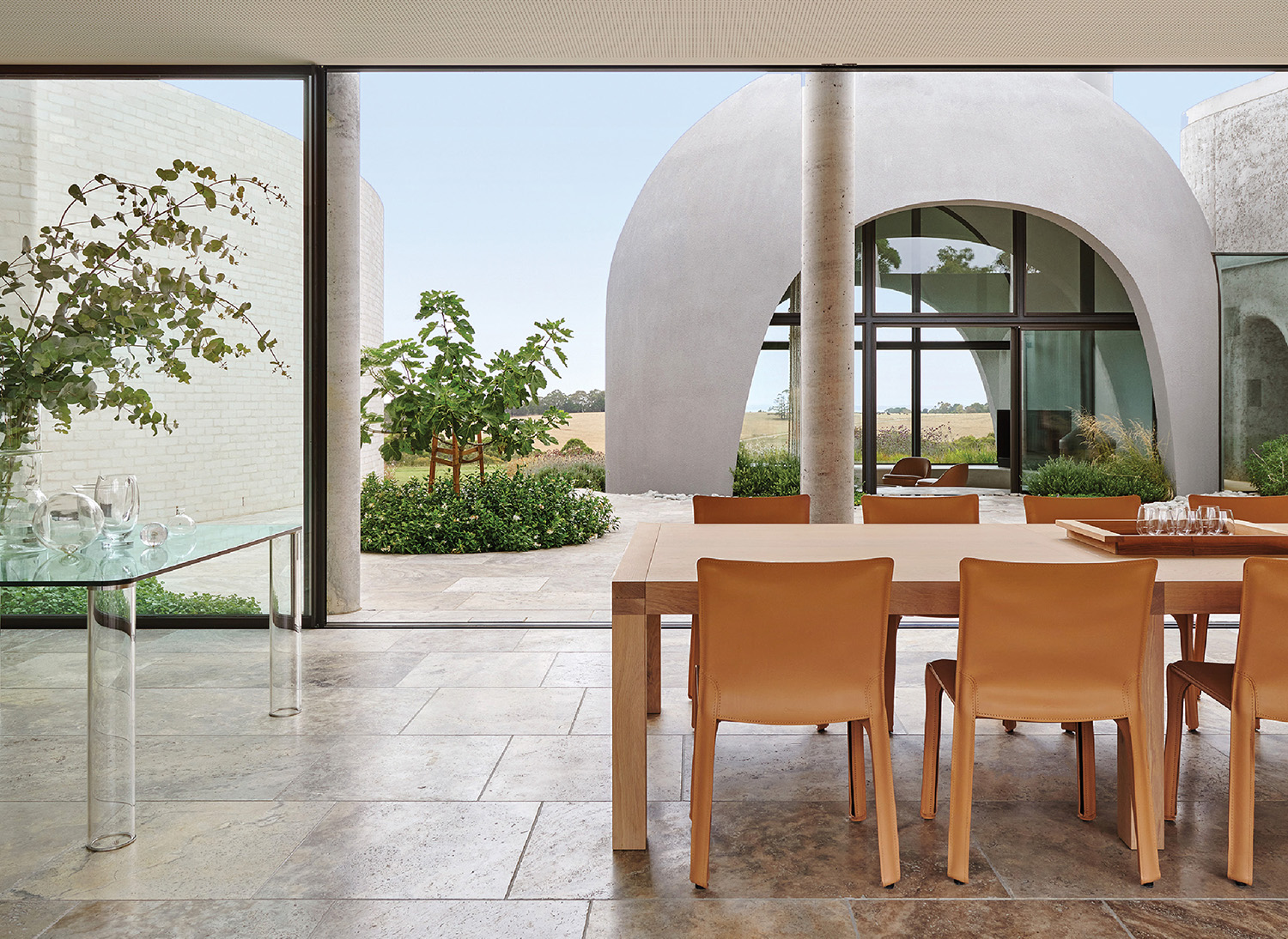
Curving brick walls thread through the floor plan, creating cocooning interior spaces and a series of sheltered outdoor areas, including the central courtyard and a sun-baked swimming-pool terrace. A massive, almost geologic architectural element of sprayed concrete over steel framing runs like a spine through the center of the house. With its biomorphic shape and minimally smoothed finish, the structure has the mythological heft of a sleeping dragon guarding its hoard—its tail at the front door, its snout pushing through the southern facade. In fact, this sculptural form encloses a mudroom, butler’s pantry, and wine cellar, and also contains a pair of tunnellike portals leading, respectively, to the dining gallery—a long, fully glazed space that can seat more than 40 people at an expandable line of tables—and to the circular living room.
The latter is housed in a thin-shell concrete dome, recalling a hill town’s inevitable duomo and, more distantly, the Pantheon and other classical cupolas. The soaring volume, flanked by arched window walls overlooking the courtyard to the north and the farmland to the south, is both exhilaratingly expansive and meditatively calm. “It’s a Binishell,” Leeton notes, referencing the construction method pioneered by Italian architect Dante Bini, in which a lightweight dome is quickly erected by spraying concrete onto inflatable formwork—essentially, a giant balloon.

Pye has furnished the slightly sunken space with striking simplicity—little more than a pair of leather-upholstered lounge chairs and a vast custom sofa that follows the curve of the wall, transitioning into concrete benching that supports a freestanding fireplace at one end and forms steps leading up to the courtyard at the other. “Our work needs to be very quiet when the architecture’s so extraordinary,” the designer, who frequently partners with Leeton, observes. “It’s all about responding to those forms and getting the balance right.” Since domes can create acoustical problems, that response includes noise-dampening materials and finishes such as thick wool carpeting and sound-absorbent plaster—not to mention the pillowy sofa. Even the artwork—a suspended, floor-to-ceiling fiber sculpture by Louise Weaver and a foam-backed acrylic-on-linen painting commissioned from Lara Merrett—helps keep the liveliest gathering easy on the ear.
The same restrained approach informs the selection of furnishings and materials throughout the seven-bedroom house, with contrasting textures and subtle plays of light reinforcing moments of intimacy and containment within the spatial rhythm of expansion and contraction. The spine’s sprayed-concrete surface was minimally troweled to achieve a stippled effect that suggests the timeworn patina of archaic monuments. This is juxtaposed with the smoothness of the surrounding ceiling—the underside of the concrete-slab roof—and the polished plaster walls. Another texture emerges in the curved brick walls, especially prominent in the main bedroom and in the arcs that define two nearly touching volumes for the other bedrooms, as well as the recreational space that adjoins them. Flooring likewise helps merge or separate areas: oak planking in the large multizone kitchen and adjacent spine; thick wool carpeting in the enclosed living room and bedrooms; and travertine paving in the dining gallery and neighboring courtyard, which unites them into a grand public space.

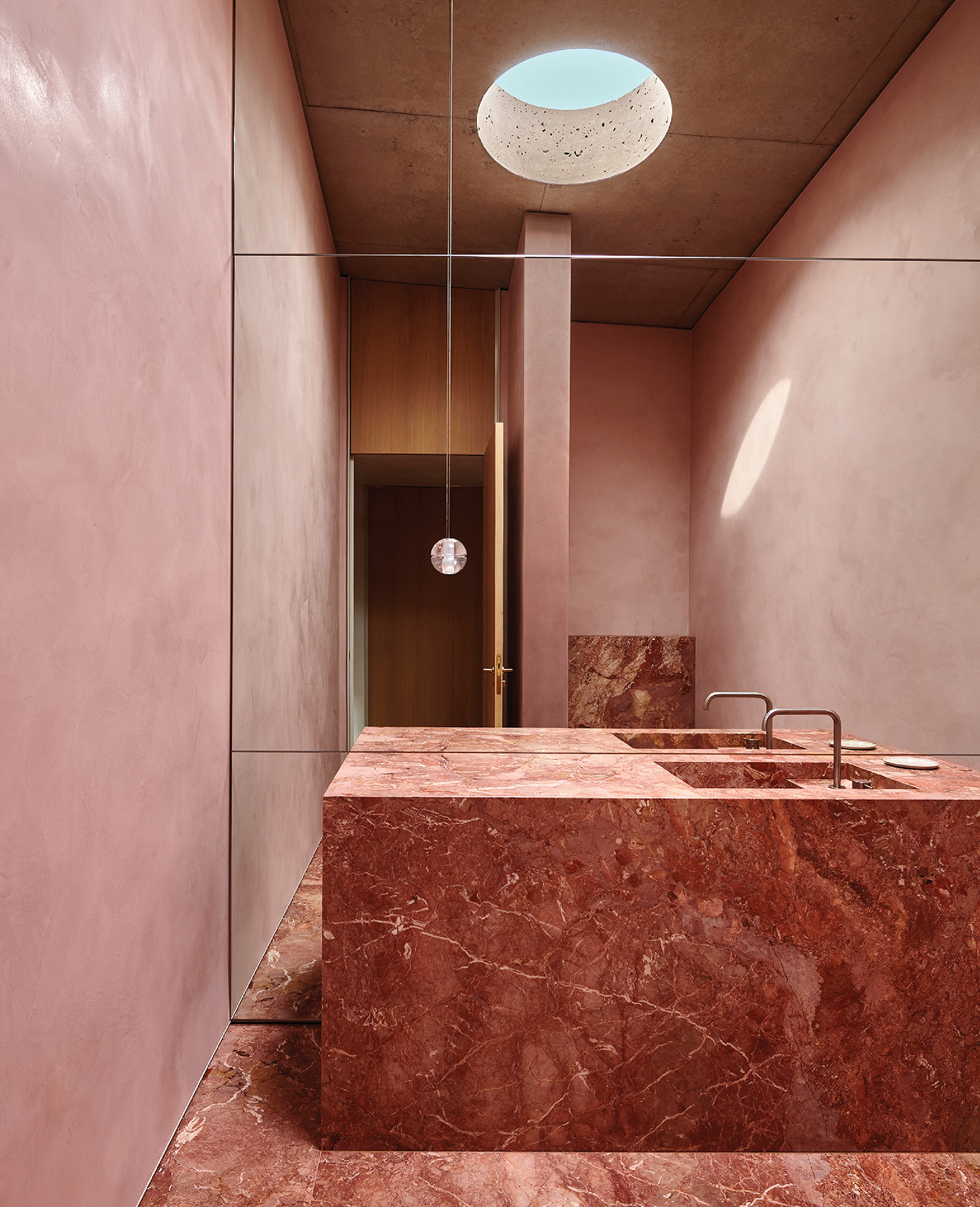
A series of oculi not only draws natural light deep into the center of the house but also sets a more relaxed diurnal tempo for its occupants. “Big circles of sunlight move around the floor during the day,” Leeton observes. “It’s a lovely way to measure the passing of time, particularly when you’re on holiday.” Even the powder room gets its own circular skylight, casting an animating beam into the sequestered space. With a custom sink and floor clad in oxblood-veined Tiberio marble, and plaster walls tinted to match, it’s the most overtly colorful room on the property. But while the clean lines and crisp fittings may be unmistakably modern, that James Turrell-esque glimpse of the heavens brings an aura of ancient rituals with it.
Simplicity Reigns In This Australian Country Home





PROJECT TEAM
LEETON POINTON ARCHITECTS: KATE POINTON; KIM JANG YUN; STACY AMBELAS. ALLISON PYE INTERIORS: SOPHIE LINDBLOM-TAYLOR; DONNA ZIMBARDI; CHRISTINE JOUBERT. SARAH RITSON: ART CONSULTANT. PAUL BANGAY GARDEN DESIGN: LANDSCAPE CONSULTANT. CAMM UPHOLSTERY; ALEXANDER J COOK; DISTINCT JOINERY; MOTTO FURNITURE & CABINETRY: CUSTOM FURNITURE WORKSHOPS. STONE ELEGANCE: STONEWORK. FELICETTI: STRUCTURAL ENGINEER. LBA CONSTRUCTION GROUP: GENERAL CONTRACTOR.
PRODUCT SOURCES
FROM FRONT
CASSINA: SIDE CHAIRS (STUDY, KITCHEN, GALLERY). BARBERA DESIGN: TABLE (PORCH). RIVA 1920: WOOD STOOLS. PAOLA LENTI: ARMCHAIR (PORCH), CERAMIC SIDE TABLES (LIVING ROOM, POOL), LOUNGE CHAIRS (COURTYARD, POOL). DAVIDE GROPPI: PENDANT FIXTURE (KITCHEN). KNOLL: DINING TABLE. BASSAMFELLOWS: STOOLS. MINOTTI: ARMCHAIRS, LARGE COFFEE TABLE (LIVING ROOM). FOCUS: FIREPLACE. MOROSO: OTTOMAN. SP01 DESIGN: SIDE TABLES. GLAS ITALIA: GLASS TABLE (GALLERY). E15: TRAY (GALLERY), STOOL (DRESSING ROOM). VOLKER HAUG STUDIO: SCONCES (NOOK). ARTEMIDE: WALL LAMP. RESIDENT: SIDE TABLE. HAY: LOUNGE CHAIRS (FIREPIT). THE DHARMA DOOR: BASKET (DRESSING ROOM). DEDON: SUNBEDS (POOL). KETTAL: SOFA. STUDIO HENRY WILSON: DOOR HANDLE (CELLAR). BOCCI: PENDANT FIXTURE (POWDER ROOM). VIABIZZUNO: TABLE LAMPS (BEDROOM). PROSTORIA: NIGHTSTAND. THROUGHOUT DULUX: PAINT.
read more

Projects
Sip The Day Away In Buno Coffee’s Latest Outpost In Toronto
For Bruno Coffee’s latest outpost in Toronto, Architecture Riot creates a minimalist atmosphere that encourages customers to sip slowly.
Projects
Inside A Frank Gehry Gem Reimagined As An Art Haven
Mariagroup transforms an artistic Frank Gehry apartment in London facing the Battersea Power Station into a light-filled collector’s home.