

Brick By Brick: Rediscover Play at the Lego Group Boston Hub
Ask an architect how they got started, and there’s a good chance they’ll mention a childhood obsession with Lego bricks. “Our entire team loves them,” affirms Lydia Randall, director and ESG lead at BDG Architecture + Design, recalling building toy bridges with them. That history came in handy as she, creative director Mitch James, and their BDG associates conceived the Lego Group Boston Hub, otherwise known as the Danish company’s U.S. headquarters. Everyone intuitively understood how two Lego connect, she says, and that simple concept informed the design of the 157,000-square-foot workplace.
Lego grip together when round studs on the top of one piece click into the tubes on the bottom of another. “They interlock to give you a unique clutch power that holds your creation together but can be disassembled to make something new,” says Skip Kodak, a Lego Group senior vice president and lead executive for the Boston Hub. “It’s a key part of our brand. That versatility and ability to iterate had to come through here.”
Step Into a World of Imagination at the Lego Group Boston Hub

BDG has worked with the toy company for many years, formulating sales offices and production facilities around the world. But the Boston project is a much larger scale, a global hub for 800 employees spread across six floors. For 50 years, the Lego Group’s U.S. base was in Enfield, Connecticut; it moved to Boston to expand its capabilities and attract top talent. An inspiring workplace that forged a sense of community was crucial to this strategy. The Lego Group asked BDG to create an office that felt both playful and sophisticated, incorporating its identity in fresh and subtle ways. (Lego, by the way, is an abbreviation for leg godt, Danish for play well.)
The program includes a barista bar, more than 90 casual and formal meeting areas, and unique spaces like a novelty showroom and a creative play lab, where the innovation team explores ideas for new Lego sets. BDG conceived a floor plan that, Randall says, “creates attractive destinations and dynamic journeys up and down the building.” The team placed collaborative and social zones on the interior of each floor and open workstations along the perimeter, democratizing the views, which encompass Back Bay, Fenway Park, the Charles River, and the Emerald Necklace parks.
BDG Architecture + Design Brings Fun Into The Lego Group Workplace

Circles representing the stud and tube of a Lego brick appear throughout in various scales, from penny tiles to meeting rooms. The scheme centers on a colorful spiral stair wrapped in tubular acoustic felt; a semicircular huddle space marks each landing. “We planned little moments of discovery and different types of areas for people to work in,” James adds. Employees may use curtained circular rooms for focused work or informal meetings, or hunker down in cozy nooks hidden under the stairs. They can also noodle around in a play space with buckets of botanical-themed Lego and green base plates along the walls, or idly stack pieces applied to the side of columns. For the Lego Group, the toy’s ubiquity is strategic. “Play helps people unlock potential,” Kodak explains, “because as they physically do something, it enables their brain to move as well, as opposed to being stuck.” Thus, there’s a bin of Lego in every meeting room.
It wasn’t easy to bring such playfulness into a professional setting. “A challenge with Lego is making it feel fun and creative without it looking like kindergarten,” James continues. “It requires a controlled use of color while adding different types of materiality, texture, and pattern.” BDG ensured that workspaces feel calm and neutral and reserved louder tones for common areas.
Unleash Your Inner Child at This Colorful HQ
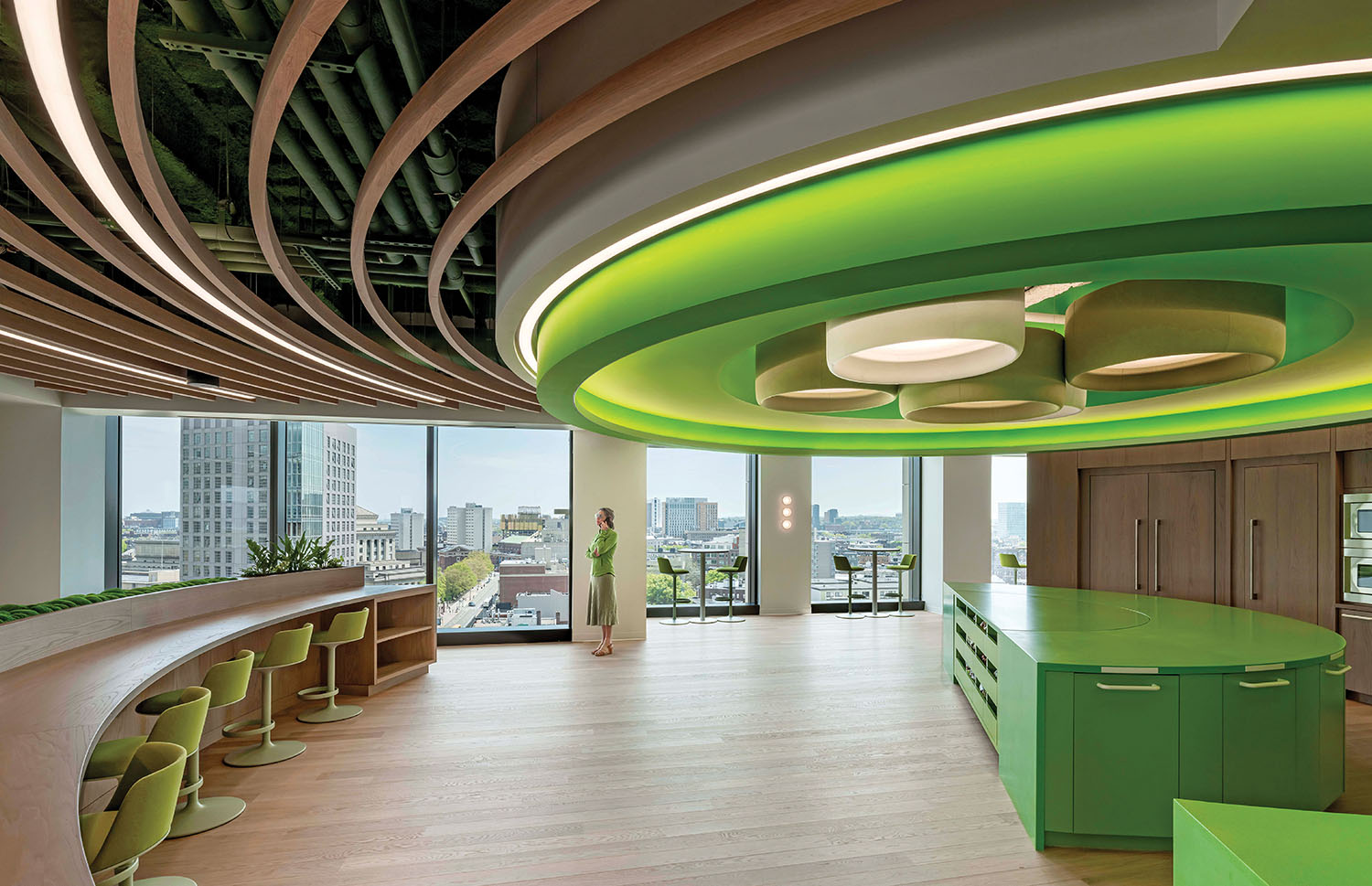
The team dialed back on the primary shades used in the brand’s logo and incorporated a wider palette that also informs wayfinding. Each floor has a color identity balanced with complementary hues. The reception level is green, a nod to the Emerald Necklace, while the barista bar is swathed in trademark Lego yellow. Passersby can see the stack of colors from the street.
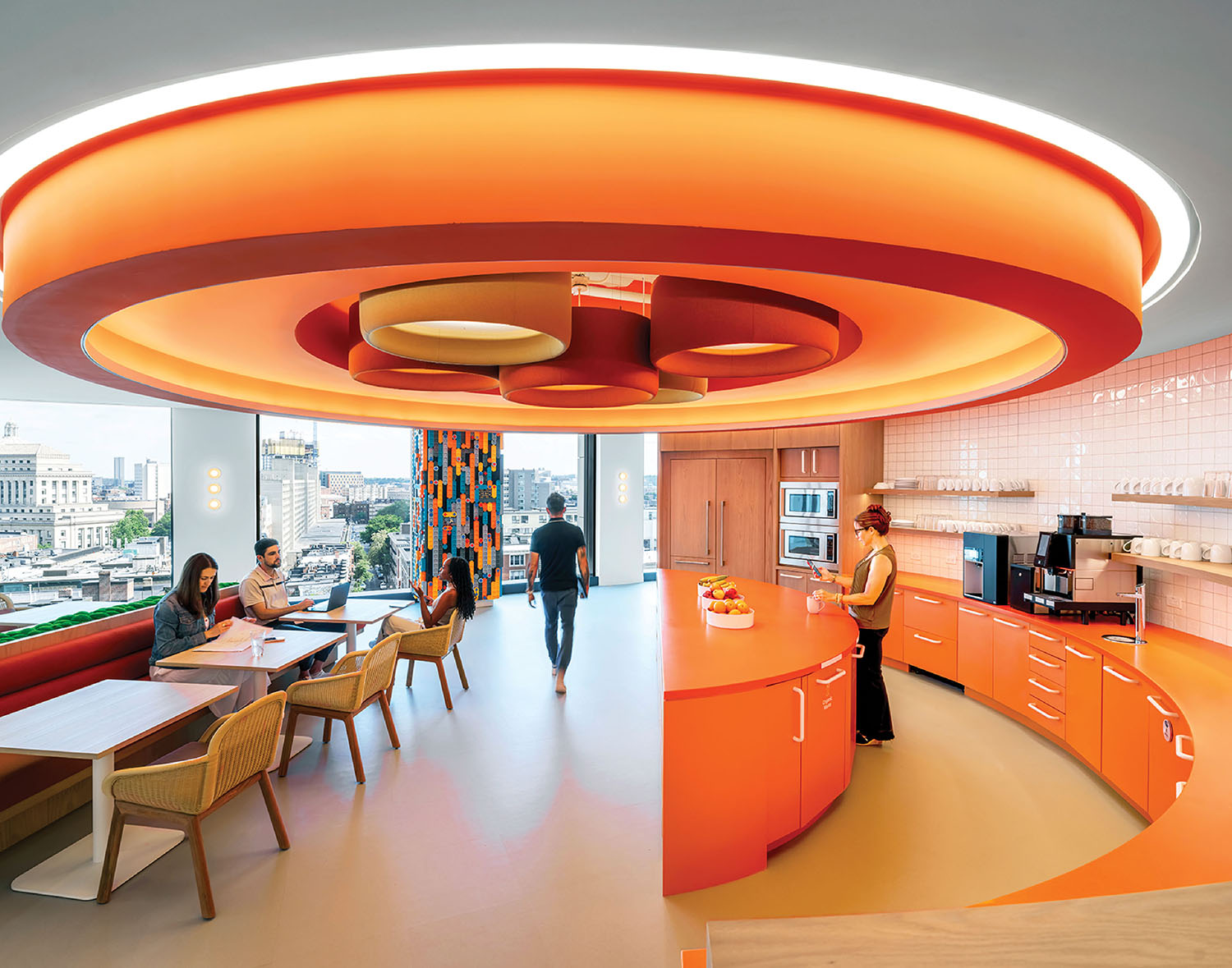
And it goes beyond simply splashing bright paint on the walls. Color is brought in through a variety of materials, like ceramic tile, acoustic felt, and Formica. “The number of finishes in this project is massive—much more than we usually use,” James notes. For instance, in the pantry on the orange floor, the color appears on the lacquered island, pendant fixtures, and banquette upholstery; for the backsplash, glossy white tiles have circular reliefs that subtly reinforce the stud and tube motif. “There are repeated themes, so even if the color changes, there’s a sense of familiarity on every floor,” Randall says.
See How Legos Are Incorporated Into the Workplace Design


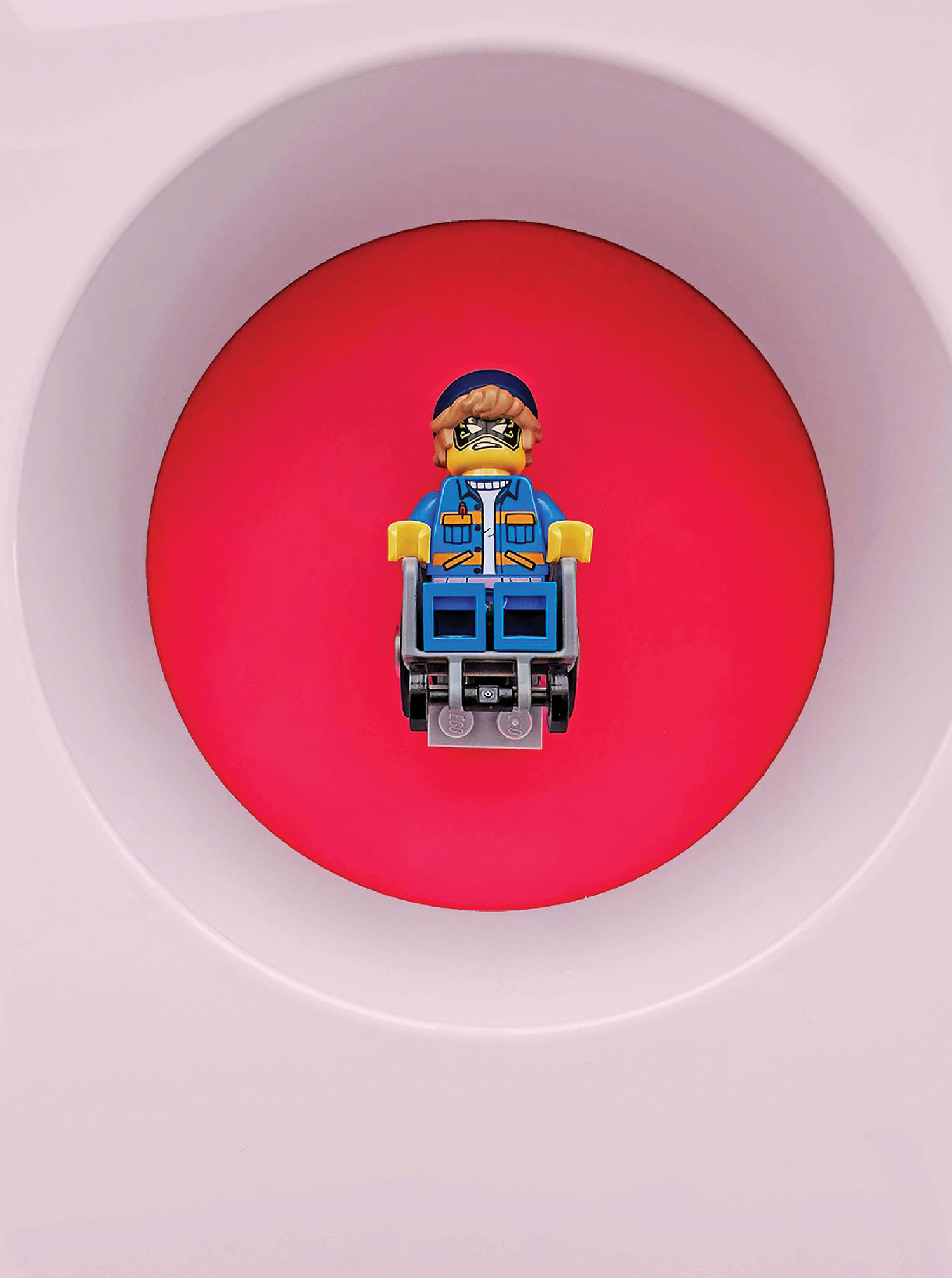
Lego infuse the decor in surprising ways. In the elevator lobbies, painted high-density foam forms inspired by them serve as lift signs, and integrated circular niches contain Lego Minifigures chosen by employees. Pendants in the barista bar look like glass orbs but are in fact made entirely of Lego; BDG produced them in collaboration with the company’s model shop. The bricks also compose color blocks along the wall in reception, continuing in vinyl streaks across the ceiling—and a single, nearly 13-foot-long one in white solid-surfacing forms the desk. “Lego bricks are considered part of the architecture, they’re baked into the design,” James says. But that doesn’t make them any less fun: A line of plastic yellow ducks near the desk honors a classic children’s book set in Boston.
Employees are loving all of it. “The space has a spirit and an energy that makes them excited to show up,” Kodak says. Hybrid workers are spending more days in the office, and colleagues feel connected. And BDG keeps building this vibe: The firm is currently working on the Lego Group London Hub.
Inside The Lego Group’s Colorful Boston HQ


Architecture Meets Imagination at This Workplace


A Workplace Rooted In Creativity






PROJECT TEAM
PROJECT TEAM
BDG ARCHITECTURE + DESIGN: TOBY NEILSON; TANIA BAGULEY; YATIN PATEL; JOYCE PUN; SHUCHEN WANG. MOBILE OFFICE ARCHITECTS: ARCHITECT OF RECORD. THE FURNITURE PRACTICE: FURNITURE CONSULTANT. ACRYLICIZE: BRANDING, SIGNAGE. LUX COLLABORATIVE: LIGHTING DESIGN. MCNAMARA SALVIA: STRUCTURAL ENGINEER. SYSKA HENNESSY GROUP: MEP. MARK RICHEY WOODWORKING: MILLWORK. STRUCTURETONE: GENERAL CONTRACTOR. OPTIMIST ADVISORY; REDGATE: PROJECT MANAGERS.
PRODUCT SOURCES
PRODUCT SOURCES
FROM FRONT
+HALLE: SOFAS, TABLES (6 COLLAB, 9 COLLAB), CHAIRS (NOOK). BUZZISPACE: PENDANT FIXTURES (6 COLLAB, PANTRIES). BLÅ STATION: SOFAS, TABLES (7 COLLAB), CHAIRS (7 LANDING). TURF DESIGN: CEILING BAFFLES (TOWN HALL), WALLCOVERING (NOOK). COR: SIDE TABLE (PANTRY). CREATACOR: CEILING VINYL (RECEPTION). FEELUX LIGHTING: NEON STRIPS. SANCAL: TABLE (NOOK). RBW: PENDANT FIXTURE. OBJECT CARPET: RUG. KVADRAT: CURTAIN FABRIC. ARCH STREET: PARTITIONS (MEETING ROOMS). BENTLEY MILLS: BLUE CARPET. NANIMARQUINA: RUG (10 LANDING). A-N-D LIGHT: PENDANT FIXTURES (LANDINGS). ARCHITECTURAL FLOORING RESOURCE: FLOORING (GREEN PANTRY). ANDREU WORLD: STOOLS. LUMENWERX: CURVILINEAR PENDANT FIXTURE (PANTRIES). TEGAN LIGHTING: CURVILINEAR COVE. EUREKA: PENDANT FIXTURES (OFFICE AREA). HUMANSCALE: TASK CHAIRS. HOLMRIS B8: DESKS. MOSA: BACKSPLASH TILE (ORANGE PANTRY). KETTAL: CHAIRS.
THROUGHOUT
ZANDUR: CORK-RUBBER FLOORING. EGE: CARPET TILE. FORMICA: CABINETRY. BENJAMIN MOORE & CO.; SHERWIN-WILLIAMS COMPANY: PAINT.
read more

Projects
Timeless In Toronto: Where Clean Lines Meet Contemporary Living
A Glenrose Tudor residence in Toronto gets a chic, contemporary update from RZ Interiors, featuring metallic accents and pared-down furnishings.

Projects
Storefront Anand Sheth Fosters Art + Ideas In San Francisco
In SF’s Mission District, designer Anand Sheth transforms a landmark deli into Storefront Anand Sheth, an immersive gallery and concept shop.