
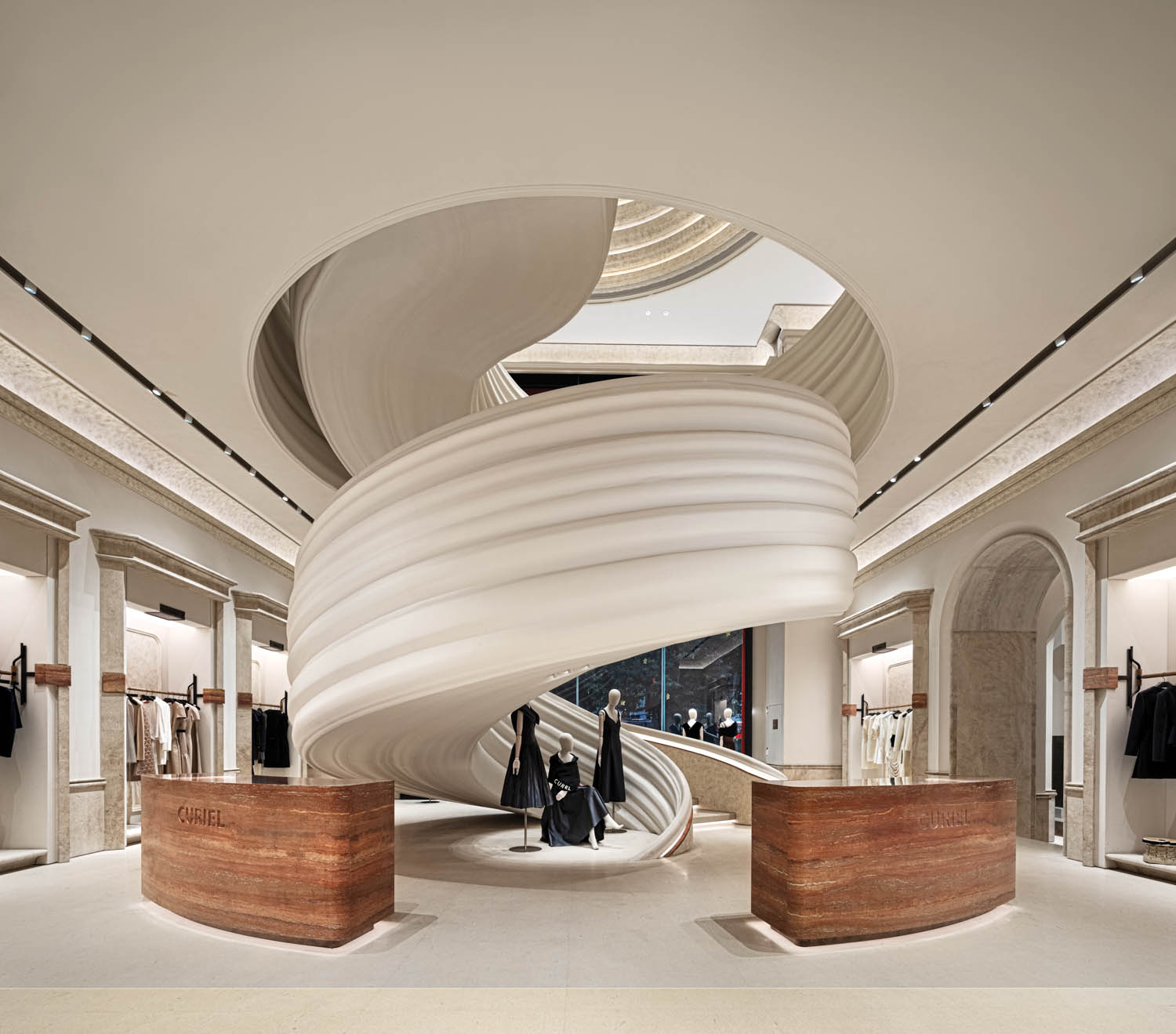
Set The Stage For Fashionable Drama At Casa Curiel Chongqing
To bring the spirit of Curiel, a century-old Milanese women’s fashion brand, to southwest China, Liang Architecture Studio founder and design director Liang Xu pulled inspiration from one of the Italian city’s most beloved cultural buildings. “We extracted elements of Teatro alla Scala to tell the story of the brand through opera,” explains Xu of his concept for the recently completed, 9,700-square-foot Casa Curiel in Chongqing, which was soon followed by Casa Curiel Beijing, as the legacy label establishes a strategic foothold in China’s luxury retail sector. While “the three-act structure of an opera helped lay out our spatial circulation,” Xu continues, the physical parts of a theater stage provided a tool kit of shapes for the interior architecture. Moving through the two-story Chongqing shop feels like an event itself.
The theatrical experience begins upon encountering the facade, a parabolic form of red anodized aluminum that appears like a curtain parting over the entrance and large windows. Once inside, the upscale garments are “the protagonists of the La Scala stage,” Xu adds, displayed on mannequins nestled in built-in apses with limestone wainscoting. Across the two levels, custom clothing racks—including limestone- paneled versions on the ground floor and handsome brass-paneled ones in the upstairs VIP lounge—and red-travertine vitrines also offer these luxurious wares, including collections of evening dresses fit for a night out at the opera. (Curiel identifies itself as the “Italian pioneer of the little black dress”.) A monumental central stair whisks visitors up to the second level, where the most climactic experiences occur—personalized shopping in the VIP rooms, each space decorated with bespoke furnishings, or a meal in the Curiel Salon restaurant.
Curiel’s Flagship Channels The Drama Of The Stage

Xu’s architectural inspiration alludes to the history of the Curiel fashion house itself, founded in 1908 by Ortensia Curiel and associated with the arts staged at La Scala since 1945, when the brand’s second-generation heir, Gigliola Curiel, created singers’ costumes for premieres. The swirling movement of these artists in silk informed the boutique’s statement staircase, a freestanding limestone spiral with marble steps, its ridged exterior accepting diffused light from the illuminated rotunda it sits within. Above the upper landing, a dome features a decorative plaster rosette and hand-painted lacquer detailing, a new technical exploration for Xu’s studio that pays “homage to the spirit of Italian craftsmanship,” he describes.
Milanese craft also influenced the project’s material palette. Downstairs, limestone clads archways and builds pilasters and decorative lintels over clothing rack niches. Upstairs, the portals that welcome visitors into the VIP area and Curiel Salon are built with more red travertine and Doric-style bluestone columns. Marble and oak parquet flooring tap into this historic tradition, too. Through their saturated hues, these natural materials create moments of visual focus within the largely neutral environment and mark transitions into the more exclusive spaces. Only the VIP area features a non-neutral wall color: a sunsetlike mural that brings warmth and a pleasantly soft contrast to the dresses that hang in front of it.
Liang Architecture Studio Weaves Natural Hues Into The Showroom


“The interior is decorated with light colors, intended to draw attention to the detail of the clothing,” Xu explains. However, his design is “not only the fusion of architecture and fashion but also the interspersing of East and West,” he adds. With the flagship sited on Minzu Road, Chongqing’s main shopping street, Xu and his team incorporated a reference to the city’s weaving heritage inside it, as well. Diffused lighting casts shadows reminiscent of bamboo weave onto the domed painted ceiling over one room in the VIP lounge, bringing this very ancient Chinese tradition into a 21st-century form. This playful mix of old and new extends to the room’s furnishings, which include contemporary pieces—a tightly tailored sofa upholstered in fine linen, a low sculptural wooden table—paired with a yesteryear Tuscany–inspired fireplace mantel. A portrait of Raffaella Curiel, the current and third-generation successor of Curiel, is displayed over the latter.
While Xu conceived of movement throughout Casa Curiel as a tripart opera itself—with the first-floor overture, staircase crescendo, and second-story climax—he also formulated a real theater within this conceit. In Curiel Salon, pink marble–topped oak tables are arranged around a stage, swagged in red velvet curtains and ripe to host performances. Apses are filled with intimate chenille-upholstered booths, romantically lit by fringed pendant fixtures. The same frill covers the backs of some armchairs. Photographs of historic Curiel fashions and designers line the walls, surrounding the room in the brand’s own archive.
Embrace The Stylish Spirit Of Milan

“We wanted to create a scene with Milanese architectural culture to draw people into Curiel’s history,” Xu says. However, he has also created a space where the brand can begin to build its future—through new customers in a new market. Perhaps it might first be played out on the Curiel Salon stage.
Curiel Stages An Ode To The Opera In This Chongqing Flagship


PROJECT TEAM
LIANG ARCHITECTURE STUDIO: ZHOU ZESI; YU JIANZHI; ZE MAN; HU XINPING; LU XIN; CHEN WEIXIN; ZHANG XUAN; XU LIANG. CAPITAL CLASSICS: CUSTOM FURNITURE WORKSHOP. SHANGHAI FUJI CONSTRUCTION ENGINEERING CO.: GENERAL CONTRACTOR.
PRODUCT SOURCES
THROUGHOUT CENTURY WIND: CURTAIN VELVET. COZAN; NEKO: LIGHTING. YAMAUCHI: PAINT.
read more
Projects
Inside A Frank Gehry Gem Reimagined As An Art Haven
Mariagroup transforms an artistic Frank Gehry apartment in London facing the Battersea Power Station into a light-filled collector’s home.

Projects
Timeless In Toronto: Where Clean Lines Meet Contemporary Living
A Glenrose Tudor residence in Toronto gets a chic, contemporary update from RZ Interiors, featuring metallic accents and pared-down furnishings.